.webp)






Introduction
Papers, Please, created by Lucas Pope, is often described as a dystopian document-checking simulator. You play as an immigration inspector working at a border checkpoint in the fictional country of Arstotzka. Each day, you examine passports, permits, entry tickets, work passes, and vaccination records. You stamp APPROVED or DENIED.
On the surface, it appears to be a minimalist puzzle game built around pattern recognition and increasing rule complexity. But beneath its mechanical framework lies something far more unsettling: the game systematically constructs a structure in which the player becomes complicit in cruelty — not through explicit moral choice, but through economic pressure, time scarcity, and procedural design.
The central issue of Papers, Please is not simply authoritarianism. It is how systems transform ordinary people into instruments of harm — and how game mechanics make that transformation feel rational, efficient, and even necessary.
This article explores how Papers, Please engineers complicity step by step, turning bureaucracy into a moral trap.
Day One: The Illusion of Neutral Work
Simple Rules, Clear Instructions
The first day is straightforward:
- Check nationality.
- Confirm valid passport.
- Deny foreigners (initially).
There is no moral complexity yet. The rules are basic. The tasks are mechanical. The feedback is immediate.
You are not told to hate anyone. You are not given political speeches. You are simply instructed to follow procedures.
Labor Framed as Survival
You are paid per correct processing. Mistakes reduce wages. At the end of the day, you must allocate money to:
- Rent
- Food
- Heat
- Medicine
Already, the system is clear: your performance equals your family’s survival.
Morality is secondary. Efficiency is survival.
Rule Escalation: Complexity as Control
Bureaucratic Expansion
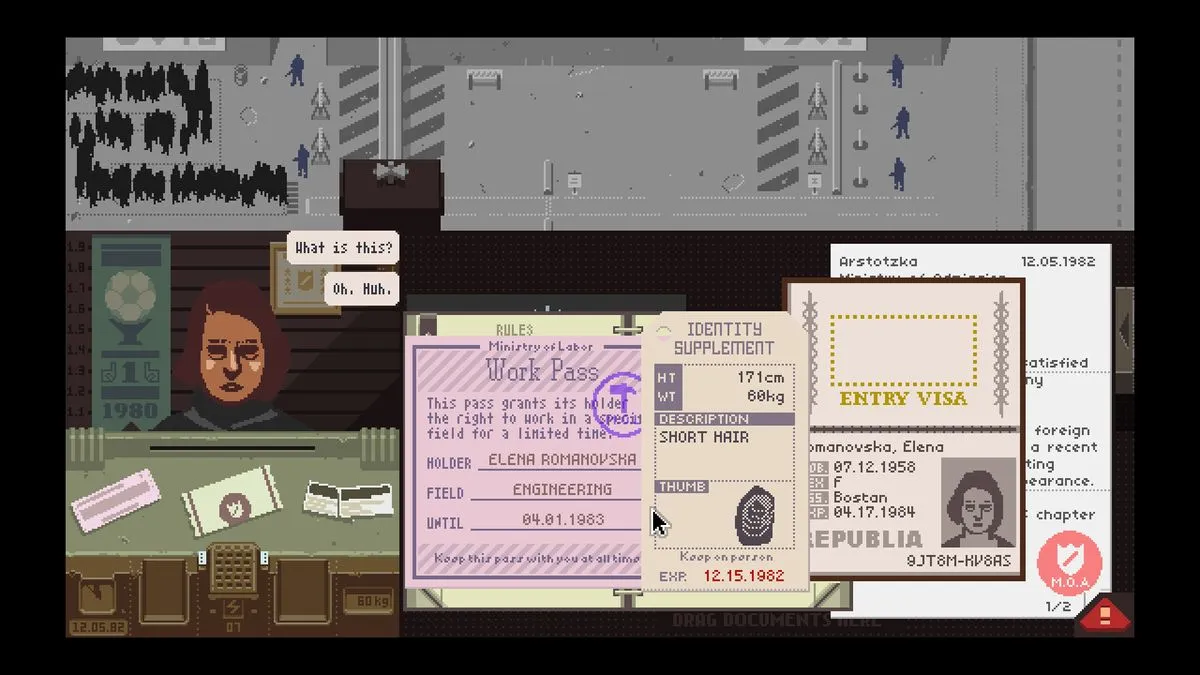
Within days, new requirements appear:
- Entry permits
- Work passes
- ID supplements
- Seals and stamps
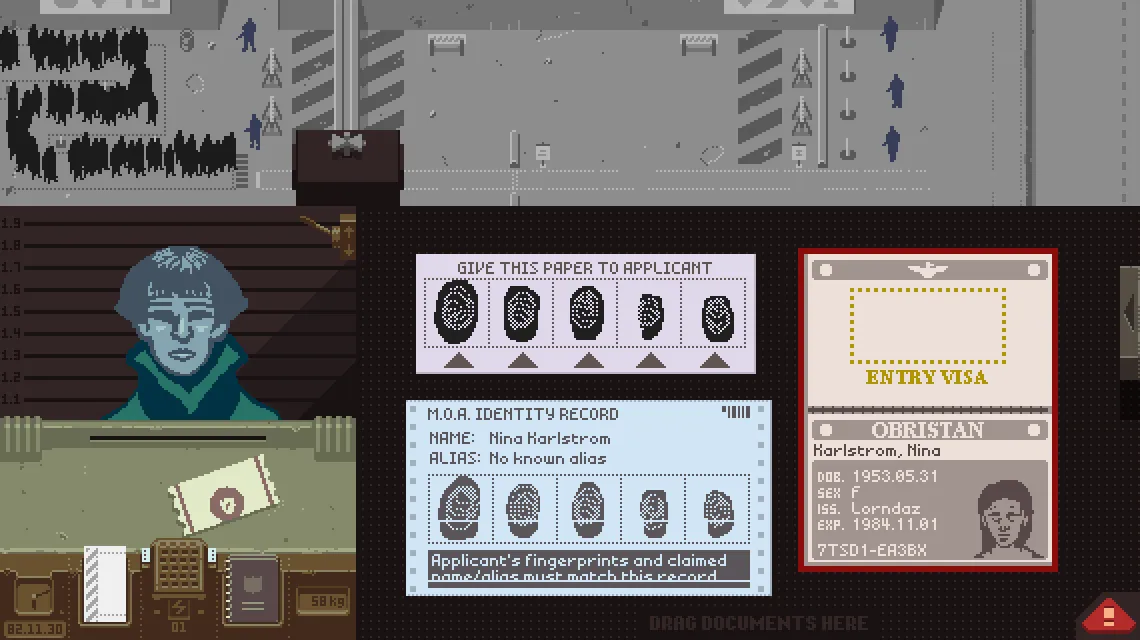
- Fingerprint verification
Each update adds friction and cognitive load.
The player’s focus shifts from human interaction to procedural compliance.
Cognitive Overload as Strategy
Time pressure increases. Lines grow longer. Rules multiply.
Under stress, empathy becomes costly.
When a desperate refugee pleads for asylum but lacks proper documentation, the player must choose between:
- Helping them (risking citation and lost wages)
- Denying them (ensuring financial stability)
The game design ensures this decision is rarely comfortable — but often economically predictable.
Economic Scarcity as Moral Weapon
Family as Leverage
Your son falls ill. Your uncle needs medicine. Heating costs rise during winter.
Every act of compassion directly threatens your household.
The system weaponizes care.
Efficiency Over Ethics
Letting someone pass illegally means:
- A citation
- Lost pay
- Potential starvation at home
The game rarely punishes cruelty directly.
It consistently punishes inefficiency.
The Stamp as Symbol of Power
Mechanical Finality
The stamping mechanic is tactile and immediate.
APPROVED.
DENIED.
There is no negotiation.
Dehumanization Through Repetition
After dozens of interactions, applicants blur into documents.
Faces become distractions.
Papers matter more than people.
The game trains the player to prioritize consistency over compassion.
Terrorism and Fear Amplification
Escalating Threats
Bombings occur at the checkpoint. Guards are killed. Political instability rises.
Security measures intensify.
The narrative introduces fear to justify harsher enforcement.
Manufactured Justification
With danger present, denying entry feels protective rather than cruel.
The player’s moral discomfort softens.
Security rhetoric becomes internalized through gameplay, not cutscenes.
Resistance Paths and Their Costs
Joining EZIC
A secret organization, EZIC, recruits you to undermine the regime.
You can:
- Allow specific agents through
- Sabotage procedures
- Cooperate with conspirators
The Price of Defiance
Resistance carries risk:
- Financial penalties
- Imprisonment
- Family consequences
Even rebellion is mediated through paperwork.
The system cannot be escaped — only navigated differently.
The Illusion of Choice
Multiple Endings
Papers, Please offers numerous endings:
- Arrest
- Escape
- Regime survival
- Regime collapse
Yet most outcomes remain constrained within bureaucratic logic.
Structural Boundaries
You cannot dismantle border control.
You cannot abolish the checkpoint.
You cannot fundamentally humanize the process.
All paths operate within procedural confinement.
Time Pressure as Ethical Erosion
The Clock as Enemy
Every second spent listening to a story is a second not processing the next applicant.
Efficiency becomes instinctive.
You begin cutting conversations short.
Emotional Numbing
After hours of gameplay, the pleas lose impact.
This is not because the writing weakens.
It is because the system conditions detachment.
Minimalism as Moral Amplifier
Sparse Presentation
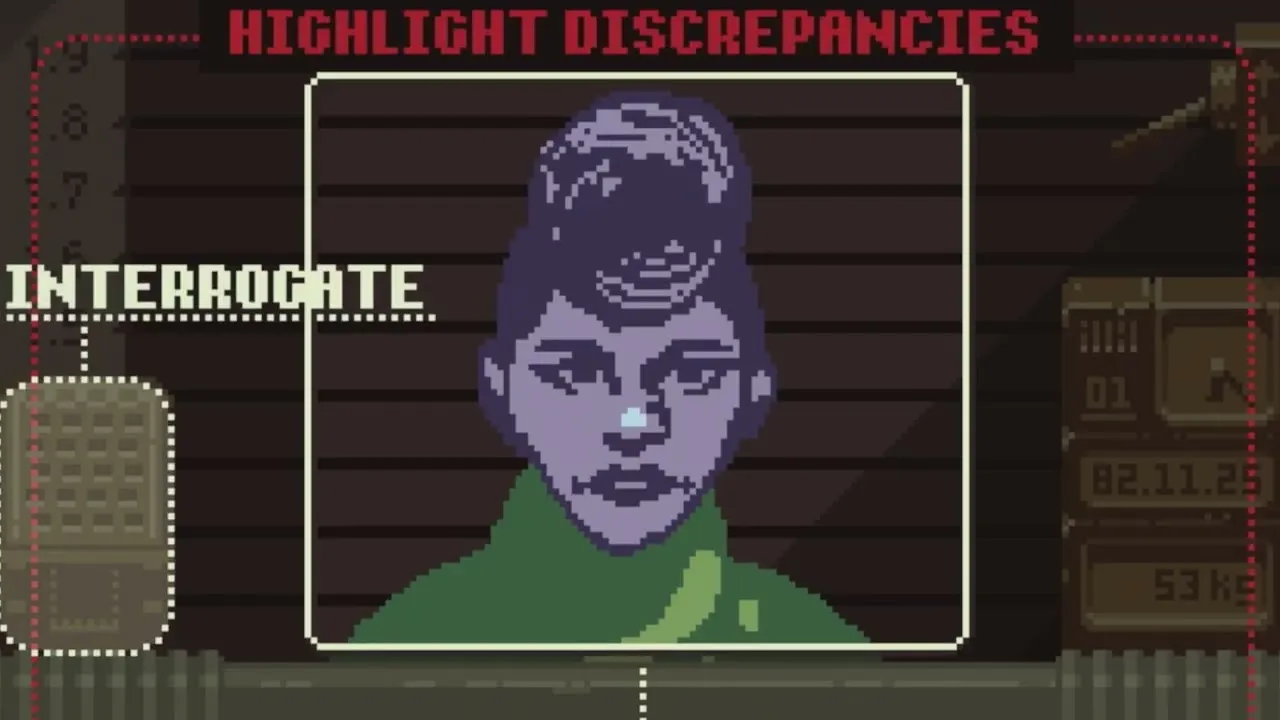
The graphics are simple. Dialogue is brief. The interface is rigid.
This minimalism removes emotional manipulation.
There are no swelling orchestral cues to guide morality.
Player Responsibility
Without cinematic framing, decisions feel self-directed.
The cruelty feels like yours.
Not scripted. Not forced. Chosen.
Bureaucracy as Character
Arstotzka as System
Arstotzka is less a nation and more a procedural machine.
Its identity is built through:
- Rule bulletins
- Daily updates
- Enforcement mechanisms
The state speaks through paperwork.
The Player as Cog
You are not a hero.
You are not a villain.
You are an employee.
That framing is the game’s most devastating insight.
Why the System Works So Well
Alignment of Mechanics and Theme
Every mechanic reinforces:
- Scarcity
- Pressure
- Hierarchy
- Compliance
There is no separation between gameplay and narrative.
They are unified.
Moral Discomfort Through Design
Papers, Please does not lecture.
It engineers situations where cruelty feels logical.
The horror emerges from rational behavior.
Conclusion
Papers, Please is not simply about authoritarianism. It is about the architecture of complicity. It demonstrates how systems — through rules, scarcity, fear, and incentives — can transform ordinary individuals into instruments of harm without overt coercion.
You are never forced to deny someone out of malice. You deny them because you need rent money. You deny them because your child is sick. You deny them because the rules say so.
The brilliance of the game lies in its refusal to dramatize cruelty. Instead, it normalizes it. It makes it efficient. It makes it profitable.
And in doing so, it reveals an uncomfortable truth: the most dangerous systems are not those that demand hatred — but those that reward obedience.
In the end, Papers, Please does not ask whether you are good or evil. It asks something far more unsettling:
When survival depends on complicity, what will you stamp?
160-character summary
Papers, Please turns bureaucracy into moral pressure, showing how scarcity and rules push ordinary players into systemic complicity.