.webp) more9game.com
more9game.com10 Pro Tips to Master Redstone in Minecraft and Automate Everything
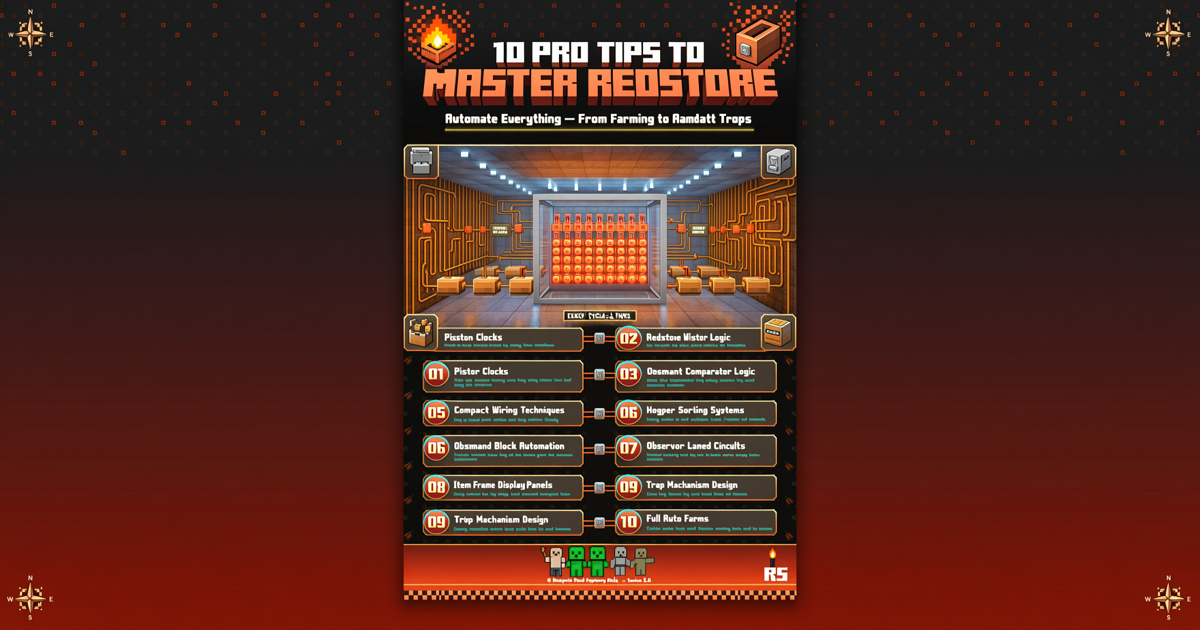
1. Understand the Basics: Power Sources and Components

Before diving into complex builds, master the fundamental redstone components. Redstone dust transmits power up to 15 blocks. Repeaters boost the signal and introduce delays. Comparators measure container fullness or compare signals. Always use levers, buttons, or pressure plates as power sources. Remember that redstone can only travel up one block without a repeater.
2. Master the Art of Redstone Clocks

Clocks pulse power at regular intervals, essential for farms or piston doors. Build a repeater clock by looping redstone dust and repeaters in a circle. Adjust the delay on each repeater to control the pulse rate. A hopper clock uses hoppers and items for precise timings. For a simple 1-second clock, use two repeaters set to 4 ticks each, looping redstone dust.
3. Compact Circuits: The 2x2 and 3x3 Doors
A classic redstone achievement is a hidden door. Build a 2x2 flush piston door using 4 sticky pistons, redstone torches, and repeaters. Dig a frame 2 blocks deep, place pistons facing inward, and wire them to a button. For a 3x3 door, use a slightly larger design with a combination of pistons and redstone blocks. Both can be concealed in walls for a sleek entrance.
4. Automatic Farms: Harvest Without Lifting a Finger
Redstone enables fully automatic crop farms. Use a water-based design with pistons and observers. Place observers facing the crops; when a crop matures, the observer triggers a piston that pushes the crop into water, which flows into a hopper. For cane or bamboo, use a simple clock and pistons to break the tops. Pumpkin and melon farms use observers to detect fruit growth and activate pistons.
5. Item Sorting Systems: Organize Your Loot
Build a silent item sorter using hoppers, comparators, and redstone torches. Each sorting module consists of a hopper facing into another hopper (the buffer) with a comparator reading the buffer. Place 1 item of your chosen type in the buffer (plus 41 of a filler item like cobblestone). When items flow through, the comparator signal activates a redstone torch to lock/unlock the next hopper. Chain modules to sort unlimited items.
6. Use Repeater Locking for Instant Switches
You can lock a repeater by powering its side with another repeater. This creates a latch circuit (like an RS NOR latch) that toggles between two states. Use this for memory cells, toggle switches, or sequential logic. A simple T-flip-flop using a locked repeater takes up only 2x3 blocks.
7. Create a Redstone Elevator
Move vertically with redstone elevators. Slimestone elevators (using slime blocks and pistons) can push you up. Build a 3-block tower with alternating sticky pistons and slime blocks, then use a clock to extend them in sequence. For a water elevator, combine soul sand (upward) or magma blocks (downward) with redstone-controlled dispensers to activate/deactivate water columns.
8. Wireless Redstone with Observers
Observers detect block state changes, allowing wireless signals over distance. Place an observer facing away from you, and trigger it by placing a block (like a redstone block) in front. The observer outputs a pulse, which can be transmitted via a chain of observers (each detects the previous) or via a redstone torch tower. This lets you activate mechanisms from across your base without visible wiring.
9. Build a Combination Lock for Your Vault
Secure your treasure with a redstone combination lock. Use a series of levers as inputs, each connected to a piston-based memory cell. Arrange them in a row, then use comparators to check if the levers match a predefined pattern. Output a signal when the correct combination is entered. Add a timer to trigger alarms on failed attempts.
10. Efficiency Tips: Keep Your Builds Lag-Free
Compact redstone reduces lag. Use observers instead of clocks where possible. Replace long redstone lines with redstone torches (they don't cause block updates). Avoid redstone loops that pulse rapidly. For large farms, spread your circuits across chunks to avoid chunk loading issues. Always build in spawn chunks if you want automation to run while you're away.
With these tips, you'll transform your Minecraft world into an automated masterpiece. Redstone mastery takes practice, but start small and experiment. Happy building!