The Queue Problem: How Guest Pathfinding and Line Management Shape Success in Waterpark Simulator
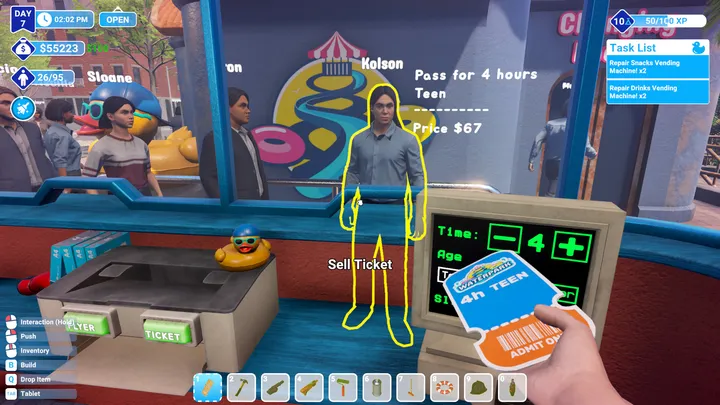
Waterpark Simulator invites players to design, build, and manage sprawling aquatic amusement parks filled with towering slides, lazy rivers, wave pools, food stalls, and thousands of guests. At first glance, the game appears to revolve around creativity—placing attractions, decorating the park, and expanding infrastructure.
However, experienced players quickly discover that the most difficult challenge is not construction or finances. The real problem lies in guest pathfinding and queue management. In large parks, visitor movement becomes unpredictable, queues spiral out of control, and poorly designed pathways create cascading operational failures.
This article examines a specific issue in Waterpark Simulator: how guest pathfinding and queue congestion gradually become the dominant factor determining park success or failure. By analyzing the progression from early park layouts to late-game megastructures, we can see how movement systems reshape the entire management experience.
1. The Early Park: When Movement Feels Simple
In the beginning stages of Waterpark Simulator, guest movement appears straightforward. Parks are small, attractions are few, and visitor flow remains manageable.
Guests enter through a single gate, walk along clearly defined paths, and distribute themselves among the available rides.
H3: Early Layout Simplicity
Initial park layouts typically include:
- A main pathway from entrance to central plaza
- Two or three water slides
- A small food court
- Locker areas and restrooms
H4: Low Visitor Density
With limited guest numbers, pathfinding works smoothly. Visitors rarely collide, and queues remain short.
At this stage, players believe park success depends primarily on ride variety and aesthetics.
2. The First Signs of Congestion
As the park grows, the number of visitors increases significantly. New attractions attract larger crowds, and previously adequate paths begin to fail.
Queues form earlier and stretch across walkways.
H3: Bottleneck Formation
Crowding occurs when:
- Multiple attractions share a single path
- Entrance areas become congested
- Food stalls block walkways
H4: Movement Chain Reactions
Once a queue spills onto the main path, it blocks other guests. Those guests slow down, creating further congestion.
The park begins to behave like a traffic system.
3. Pathfinding Algorithms and Their Limitations
Guest behavior is governed by pathfinding algorithms designed to guide visitors toward desired attractions.
However, these algorithms often prioritize shortest distance rather than congestion awareness.
H3: The Shortest Path Problem
Guests usually select the most direct route to their target ride.
This leads to situations where:
- Hundreds of guests converge on one narrow corridor
- Alternative routes remain underused
H4: Unrealistic Crowd Behavior
Real-world visitors might avoid dense crowds, but simulated guests frequently push into already packed spaces.
This design limitation intensifies traffic jams.
4. Queue Design Becomes Strategic
To control guest flow, players must carefully design ride queues rather than simply placing attractions.
H3: Effective Queue Architecture
Good queue design includes:
- Long, winding queue lines
- Dedicated queue paths separate from main walkways
- Visual barriers to prevent overflow
H4: List – Queue Design Principles
- Separate ride queues from main paths
- Allow expansion space for popular rides
- Avoid intersections near queue entrances
- Place shade or entertainment objects to increase patience
Proper queue planning becomes essential.

5. Attraction Popularity and Flow Imbalance
Not all rides attract equal attention. Some slides become extremely popular, while others remain underused.
H3: Demand Concentration
High-thrill rides often create massive lines, particularly during peak hours.
Guests ignore nearby alternatives even when waiting times grow excessive.
H4: Secondary Congestion
Large queues lead to:
- Path obstruction
- Reduced movement speed
- Guests abandoning nearby attractions
A single popular ride can destabilize the entire park.
6. Food Areas and Rest Zones as Hidden Traffic Generators
Food courts and rest areas significantly influence guest movement patterns.
H3: Gathering Points
Guests often cluster around:
- Food stalls
- Seating areas
- Locker facilities
H4: Unintended Congestion
If these facilities are placed near major attractions, visitor clusters form overlapping movement zones.
This results in unpredictable crowd density.
7. Late-Game Megaparks and Pathfinding Collapse
Large parks introduce thousands of simultaneous visitors.
At this scale, pathfinding inefficiencies become dramatically visible.
H3: Overcrowded Corridors
Common issues include:
- Guests moving extremely slowly
- Large crowd clusters near entrances
- Attractions appearing empty despite long queues elsewhere
H4: Simulation Stress
The pathfinding system struggles to process so many movement decisions simultaneously.
This can produce erratic guest behavior.
8. The Psychological Impact on Players
Poor crowd management does not only affect park efficiency—it also affects player satisfaction.
H3: The Illusion of Loss of Control
Players may feel confused when:
- Visitors complain despite available attractions
- Queues grow unexpectedly
- Profits stagnate despite park expansion
H4: Frustration from Invisible Systems
Because pathfinding calculations are hidden, it can be difficult to diagnose problems.
This creates a disconnect between player intention and simulation outcome.
9. Strategies Players Develop to Manage Flow
Experienced players eventually learn techniques to stabilize guest movement.
H3: Advanced Path Layouts
Successful parks often include:
- Multiple parallel paths
- Circular route systems
- Distributed attraction clusters
H4: List – Common Flow Control Strategies
- Create wide central boulevards
- Use decorative barriers to guide traffic
- Separate dining zones from rides
- Build secondary entrances for popular attractions
These strategies mimic real-world urban planning.
10. The Core Design Challenge
The guest pathfinding system provides realism but also introduces structural limitations.
H3: What Pathfinding Adds
The system enhances immersion by simulating:
- Crowd behavior
- Visitor preferences
- Spatial decision-making
H4: What It Restricts
However, limitations can cause:
- Traffic gridlock
- Unrealistic crowd persistence
- Reduced effectiveness of creative park designs
Future improvements could include smarter crowd avoidance and dynamic route selection.
Waterpark Simulator appears to be a game about creative construction and theme park expansion. Yet as parks grow, the true challenge emerges: managing the movement of thousands of simulated guests through a complex environment.
The pathfinding and queue systems gradually transform the game into a puzzle of traffic engineering. Poorly designed paths can cripple even the most visually impressive park, while thoughtful layouts enable smooth operations and satisfied visitors.
Understanding and mastering guest flow is therefore not a minor detail—it is the core skill required to succeed in Waterpark Simulator. Behind every successful park lies careful planning not only of attractions, but of the invisible rivers of human movement flowing between them.